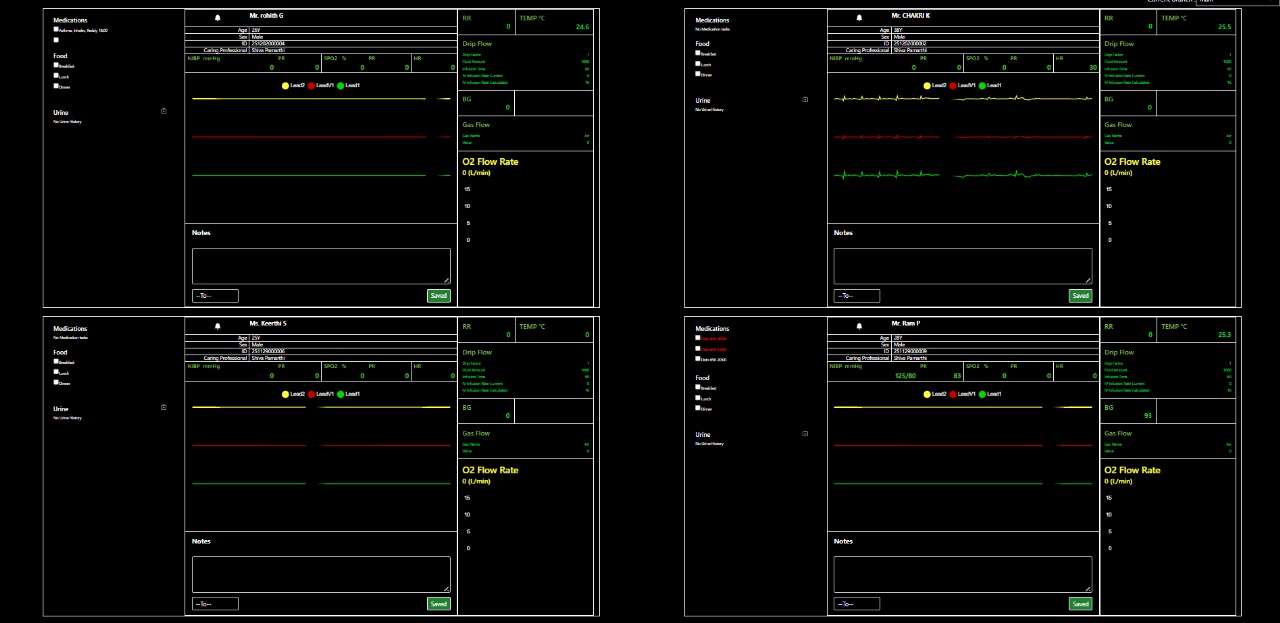
A Central Monitoring Station (CMS) serves as the nerve centre for managing multiple Intensive Care Units (ICUs) in a healthcare facility. This innovative system employs a Hub & Fork model to optimise the management and monitoring of patients across various ICUs. It combines advanced technology with the expertise of healthcare professionals to provide optimal care for critically ill patients, regardless of their location within the healthcare facility or in the world.
Key Features
The CMS combines cutting-edge technology with clinical expertise to provide optimal care for critically ill patients — regardless of location.
Centralised command centre overseeing multiple ICUs with the Hub & Fork coordination model.
Remote nursing stations with global access to real-time patient vitals and information.
Continuous real-time monitoring of all critical patient vitals with instant deviation alerts.
Remote medication management and suggestions to ensure prompt and appropriate patient treatment.
Seamless communication between the central station and individual ICUs for swift decision-making.
Designed to scale with facility needs — from small clinics to large multi-specialty hospitals.
How It Works
A centralised command architecture connecting multiple ICU stations for coordinated, real-time patient care.
The central Hub is established as the command centre. This is where all monitoring, communication, and decision-making takes place. It aggregates data from all connected ICU stations in real-time.
Individual ICU stations — the Forks — are connected to the central Hub. Each Fork transmits real-time patient data including vitals, medication records, and nursing notes directly to the Hub.
The Hub continuously receives and aggregates patient data from all connected Forks. Healthcare providers at the Hub can monitor all patients simultaneously, with instant alerts for any critical changes.
Based on the aggregated data, doctors at the central station can intervene remotely — prescribing medications, updating care plans, and communicating directly with nursing staff at individual ICU stations.
Benefits
Proven advantages of centralised ICU monitoring for healthcare facilities of all sizes.
The Hub & Fork model centralises the monitoring and management of multiple ICUs, ensuring consistent and standardised care protocols across all units.
Healthcare professionals can access patient data and make informed decisions from any location with an internet connection, enabling timely interventions and reducing response times.
Real-time monitoring and medication management lead to more precise and effective care, potentially reducing complications and improving patient outcomes.
The CMS optimises resource allocation by allowing healthcare providers to focus their attention on patients who require immediate attention, reducing unnecessary interventions.
By centralising monitoring and enabling remote management of multiple ICUs, the CMS reduces the need for additional staff at individual units while maintaining the highest standard of care.
Gallery
Explore More
Discover how MedJacket CMS transforms critical care delivery across multiple ICUs with a single, unified platform.